
Lawn mowing across Champaign and Douglas counties
Lawn mowing is the core of Russel’s Mowing and Services. The business is based in Villa Grove, and the crew mows yards in Douglas County and Champaign County, Illinois. The work is plain and regular: cut the grass at a sensible height, trim the spots the mower can’t reach, and leave the yard looking tidy.
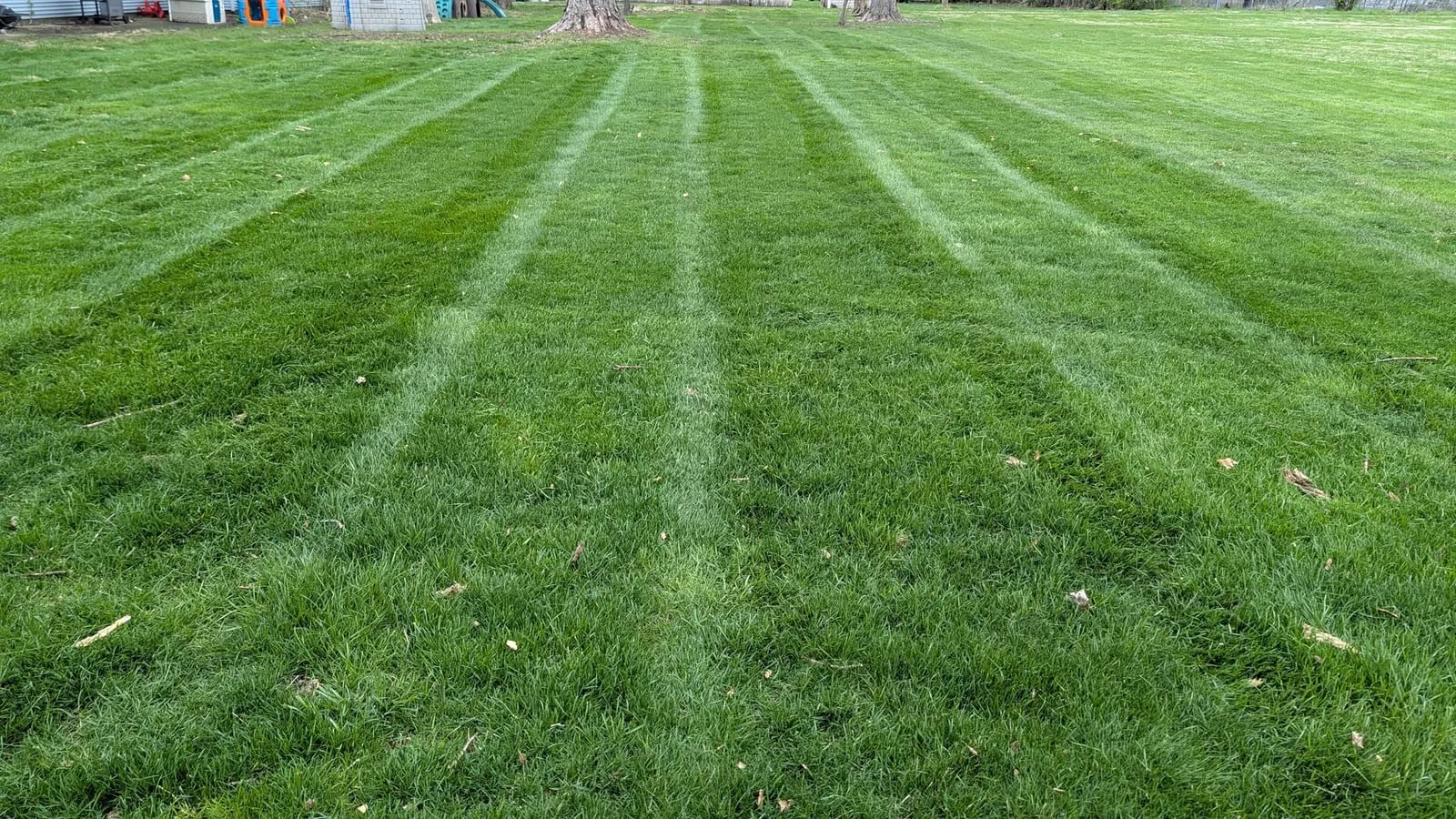
The photo on this page is one of the business’s own jobs: a back lawn with clean alternating stripes and mature trees along the edge. The crew works from a pickup and trailer with a John Deere Z515E zero-turn mower, a red commercial mower, a trimmer and a blower, which is the equipment behind that kind of finish.
Who lawn mowing is for
Regular mowing suits most kinds of residential yards in the two counties. Some common examples:
- Small-town lots that are a manageable size but still need cutting all season.
- Subdivision and city lots in Champaign County, where overgrown front yards are easy to notice.
- Rural and edge-of-town homes set on wider stretches of lawn among the prairie farmland.
- Rental properties where the owner or manager doesn’t live on site and needs the lawn kept in order.
- Busy households whose evenings and weekends are already full, so the mowing keeps slipping.
- Homeowners who can’t do the work themselves because of health, an injury or not owning a mower.
If the yard is somewhere in Douglas County or Champaign County, it is worth calling or texting to check whether it fits the route.
What a mowing visit includes
A mowing visit covers the basics that the service name implies. On a typical visit:
- The open lawn in the front, side and back yard is cut at a height suited to the grass and season.
- The edges the mower can’t reach are trimmed along fences, around trees, beside beds and next to the house.
- The yard is left with a clean finish, so the lawn looks even and cared for when the visit is done.
Anything beyond mowing and trimming, such as bed work, leaf cleanup, seeding or fertilizer, is a separate service. Those can be added on their own or booked alongside a mowing visit, and they are covered on their own pages.
Mowing height and why it matters
As a rule, cool-season lawns in Central Illinois stay healthier when they are not cut too short. General guidance for these grasses is:
- Keep the turf at around 3 to 3.5 inches.
- Don’t remove more than about a third of the blade in a single mowing.
- Leave the grass a little taller in the heat of summer, when the lawn is under stress.
Taller grass shades the soil, holds moisture better, and tends to crowd out weeds. Cutting too low, or taking off a lot of blade at once after the grass has got long, can leave a lawn looking brown and thin for days afterward. That is one reason regular mowing through the season is easier on a lawn than a heavy cut every few weeks.
Lawn mowing through the Central Illinois season
Most lawns in Champaign County and Douglas County are cool-season grasses: Kentucky bluegrass, tall fescue and perennial ryegrass, often mixed together. They grow on the heavy, dark prairie silt-loam soils common in this part of the state. Their growth follows a fairly steady pattern through the year, and that pattern shapes how often a lawn needs cutting.
Spring
Spring is when cool-season grass grows fastest. After the first green-up, lawns can put on a lot of height quickly, especially after rain. As a general rule, this is the stretch where regular cutting matters most, so the grass never gets far enough ahead that a third-of-the-blade cut isn’t possible. It is also a good time to clear winter debris before the first cuts, which is what a spring cleanup is for.
Summer
In the heat of summer, and in dry spells, cool-season grass slows down. Some lawns go partly dormant and turn tan until rain and cooler weather return. In general, this is the time to raise the mowing height a little, avoid scalping, and not cut more than the grass needs. A dormant lawn usually doesn’t need cutting as often as a spring lawn.
Fall
Cool-season grasses have a second growth flush in the fall as temperatures drop. Lawns often need regular mowing again through September and October. Late summer to early fall is also the most reliable window in Central Illinois for seeding thin or bare spots, so mowing and seeding plans often overlap at this time of year. Leaves start dropping as the season goes on, and leaving a thick layer of leaves on a lawn over winter can smother the grass underneath.
A month-by-month view of what a lawn in this area usually needs is on the lawn care calendar page.
Keeping a lawn on a regular schedule
A lawn that is cut on a steady schedule is easier to keep looking good than one that is cut only when it gets long. Some general points for Central Illinois yards:
- Mowing frequency follows growth, so spring and fall lawns usually need cutting more often than midsummer lawns.
- Mowing soaked grass on heavy silt-loam can leave ruts and clumps, so it is common to wait a little after heavy rain.
- Short clippings can stay on the lawn, where they break down and return nutrients to the soil. Heavy clumps mean the grass got too long between cuts.
- Sharp blades give a clean cut that heals faster than a torn one, which keeps the lawn looking better.
How often your yard is mowed, and on what kind of schedule, is something to talk through when you call or text.
Getting the yard ready for mowing
A few simple steps before a visit make the mowing go smoothly and help avoid damage to the mower or to things left in the grass:
- Pick up toys, hoses, garden tools, dog bowls and lawn furniture, which slow the work and can be hit by a blade.
- Clear larger sticks and fallen limbs after a storm, though small twigs are fine to leave.
- Mark sprinkler heads, low stakes, buried edging, surface roots and soft spots over old stumps, since they are easy to miss in long grass.
- Unlock gates and secure pets so the mower has a clear path into the back yard.
- Point out any areas to leave alone, such as a wildflower patch, new seeding or a vegetable garden edge.
For a lawn that has gone several weeks without a cut, it helps to mention that up front. Very long grass usually needs more time, and it may take more than one pass to bring it back to a normal height without scalping it.
What to ask when you call
A short conversation up front makes it clear what the mowing will look like for your property. Some useful questions:
- How often will the lawn be mowed in spring, summer and fall?
- Is trimming around fences, beds and the house part of every visit?
- What happens to the schedule when it rains or the lawn is too wet to cut?
- Are there parts of the yard, such as a steep bank or a fenced area, that need special handling?
- Can other jobs, such as a cleanup or mulch, be done on the same visit as a mow?
It also helps to share the address, roughly how big the lawn is, and anything unusual about it, such as slopes, many trees or narrow gates. The quote depends on the yard, and it is confirmed once the lawn has been looked at or talked through.
Adding other work to a mowing visit
Regular mowing pairs well with the jobs that come around each year. A spring cleanup gets the lawn ready for its first cuts, a fall cleanup clears leaves before winter, and fertilizer application feeds the grass at the right times. Each one is quoted on its own, so the yard gets only the work it needs.
Other services that go with mowing
Mowing keeps grass at the right height, but it doesn’t fix thin spots or feed the lawn. A few services often pair with it:
- Fertilizer application spreads feed evenly at the right times of year to support healthy growth.
- Grass seeding fills bare or thin patches, or a whole lawn, ideally in late summer to early fall.
- Spring cleanup clears winter debris and dead growth before the first cuts of the year.
- Fall cleanup deals with leaves and beds and gives the lawn a final cut before winter.
Once mowing season ends, snow removal is the winter side of the business.
Where the crew mows
Russel’s Mowing and Services mows across Douglas County and Champaign County. The two counties take in prairie farmland, small towns, and the larger cities and subdivisions of Champaign County. If your address is anywhere in either county, call or text to check whether it is on the route.
Getting a quote
For lawn mowing, call or text (217) 729-1112 for a quote. You can also use the quote form on the contact page. Share the address and a little about the yard, so the details can be talked through before the quote is given.
Photos from lawn mowing jobs
We also serve these areas
Lawn Mowing is available to homes across Champaign and Douglas counties.